
This document describes how to request age signals by using the Play Age Signals API.
The Play Age Signals 0.0.4 SDK introduces a two-function architecture designed to simplify age signal requests and support our user choice based model. To request age signals, use this high-level workflow:
Call the requestAgeSignalsAccess(Activity) method, which returns
ageSignalsStatus. The value of ageSignalsStatus can be SHARED,
NOT_SHARED, or VERIFICATION_REQUIRED.
- If
ageSignalsStatus == NOT_SHARED: Your app won't get age signals in the API response. - If
ageSignalsStatus == SHARED: Call thecheckAgeSignals()method. If the user or parent has decided to share the age signals, you receive age signals as part of the API response, and you can decide how to handle the response. - If
ageSignalsStatus == VERIFICATION_REQUIRED: The user's age is unknown and the user is in an applicable jurisdiction or region where age verification and age signals sharing is mandatory. To obtain an age signal from Google Play in these regions, ask the user to visit the Play Store to resolve their status.
The requestAgeSignalsAccess(Activity) method returns different values
depending on whether mandatory age sharing is applicable in a region:
- For eligible users in US states with laws requiring app stores to provide
verified age information to developers, the in-app prompt is not triggered.
Instead, users will be asked to verify or set up supervision when
they visit the Play Store app. Use the value of
ageSignalsStatusto determine the verification status:- If the user has completed age verification or parental supervision
is active, the value of
ageSignalsStatusisSHARED. - If the user has not yet verified their age or set up supervision, the
value of
ageSignalsStatusisVERIFICATION_REQUIRED. For more information, see Changes to Google Play for upcoming app store bills for users in applicable US states.
- If the user has completed age verification or parental supervision
is active, the value of
- For users in other regions where age sharing is based on the user's or
parent's choice:
- If the user's setting is Ask before sharing, the in-app prompt is
shown. If the user agrees to share their age, the value of
ageSignalsStatusisSHARED; otherwise,NOT_SHARED. - If the user's setting is Always Share, the in-app prompt is not
shown, and the value of
ageSignalsStatusisSHARED. - If the user's setting is Never Share, the in-app prompt is not
shown, and the value of
ageSignalsStatusisNOT_SHARED. - For supervised users, parents can choose to share the age for their
child in Family Link app settings. If the parents choose to share the
age the value of
ageSignalsStatuswill beSHAREDotherwise it will beNOT_SHARED.
- If the user's setting is Ask before sharing, the in-app prompt is
shown. If the user agrees to share their age, the value of
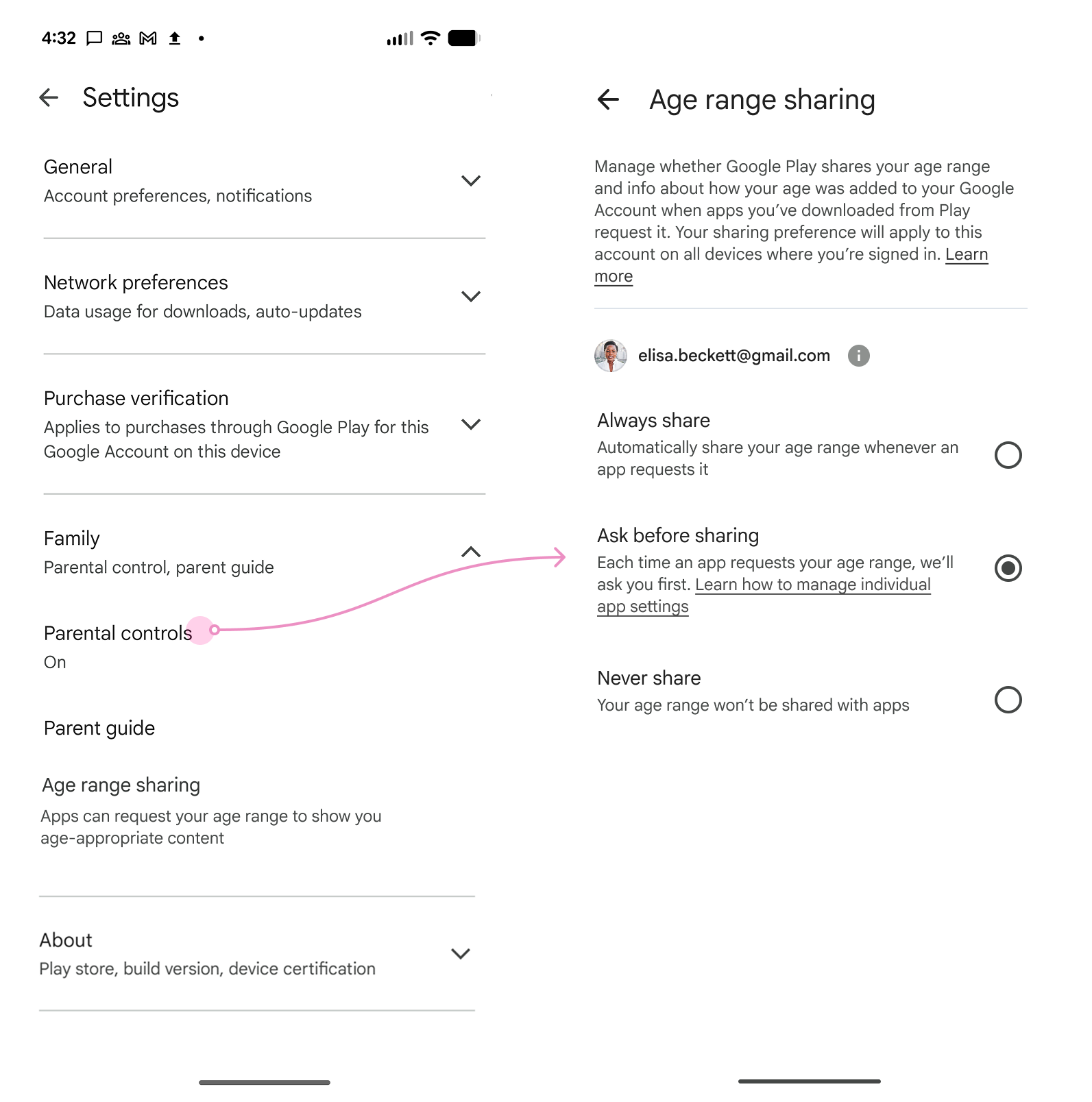
The following image shows the Ask before sharing age range configuration in Play settings.
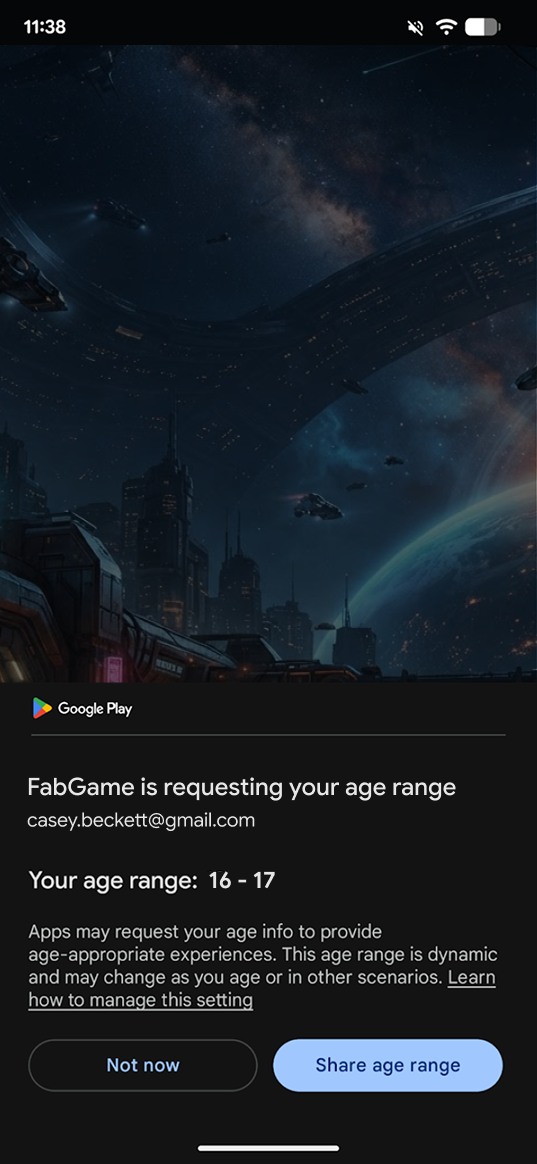
The following image shows the in-app age range sharing request shown to users when the age is requested through the API and their setting is Ask before sharing.
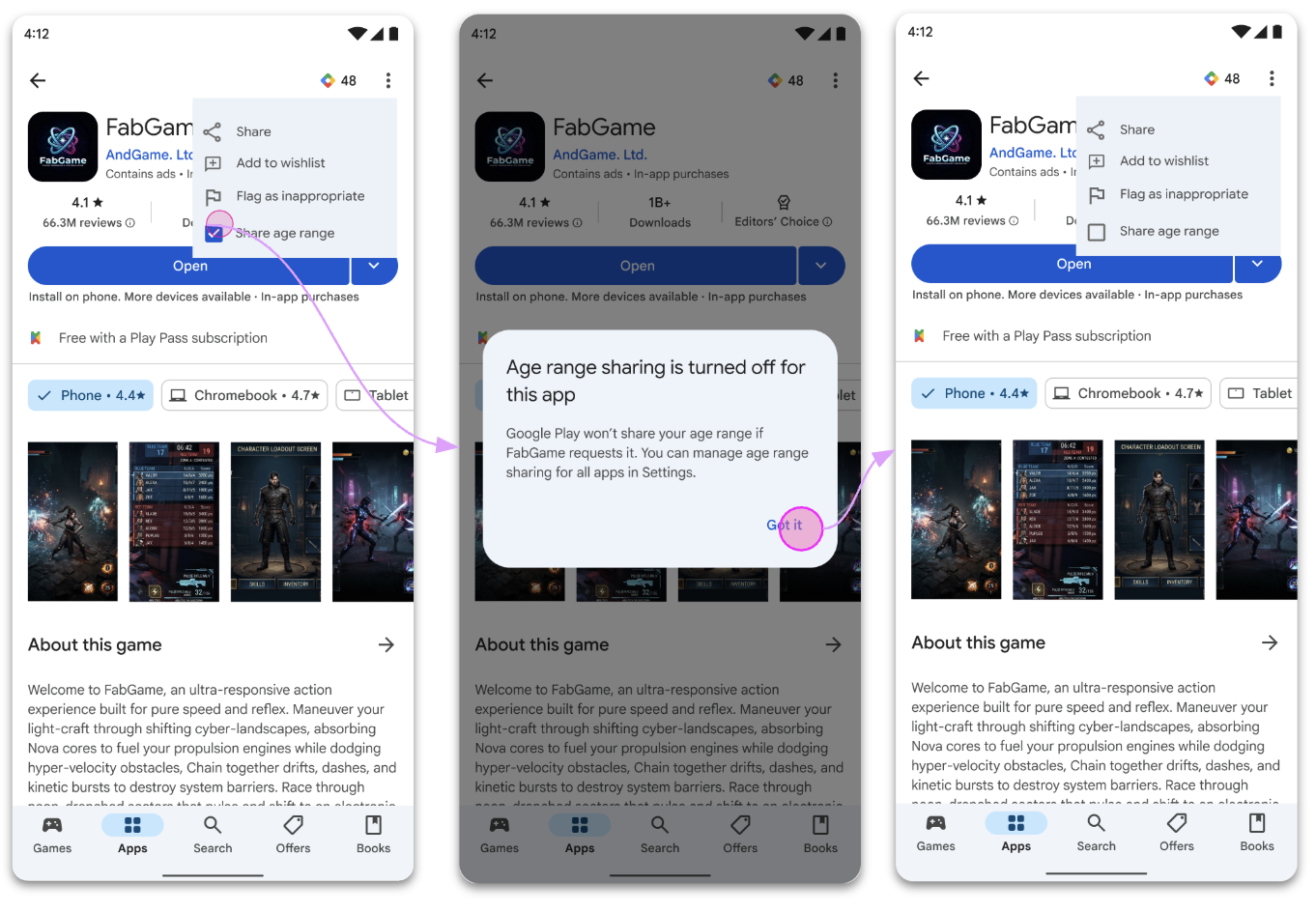
The following image shows how the user can enable or disable age share for a specific app.
The following example shows how to request for age signals:
Kotlin
// 1. Initialize the AgeSignalsManager (usually in onCreate or class initialization)
val ageSignalsManager = AgeSignalsManagerFactory.create(applicationContext)

// 2. Request or check for age signals access.
// Passing the current Activity allows the Play Store to render the age sharing prompt UI if required.
val accessRequest = AgeSignalsAccessRequest.builder()
    .setActivity(this)
    .build()

ageSignalsManager.requestAgeSignalsAccess(accessRequest)
    .addOnSuccessListener { accessResult ->
        if (accessResult.ageSignalsStatus() == AgeSignalsStatus.SHARED) {
            // The user (or parent) has agreed to share age range, or is in an eligible auto-share region.
            // Retrieve the actual age signals.
            retrieveAgeSignals(ageSignalsManager)
        } else {
            // Age signals are not shared (user didn't share age range, parent rejected the request, or not eligible).
        }
    }
    .addOnFailureListener { exception ->
        // Handle API/Play Store connection and system errors
        handleAgeSignalsError(exception)
    }

private fun retrieveAgeSignals(manager: AgeSignalsManager) {
    // 3. Perform the actual age signals query once sharing is active.
    manager.checkAgeSignals(AgeSignalsRequest.builder().build())
        .addOnSuccessListener { ageSignalsResult ->
            val installId = ageSignalsResult.installId()
            val ageLower = ageSignalsResult.ageLower()
            val ageUpper = ageSignalsResult.ageUpper()
            val significantChangeDate = ageSignalsResult.significantChangeApprovalDate()
            val ageRangeSource = ageSignalsResult.ageRangeSource()

            if (ageLower != null) {
                if (ageUpper != null) {
                    // The user is in a specific closed age range [ageLower, ageUpper] (e.g. [13, 15])
                } else {
                    // The user is in the highest open-ended age band [ageLower, null] (e.g. [18, null])
                }
            } else {
                // Both bounds are null: The user is not sharing their age (e.g. they are a verified adult)
            }
        }
        .addOnFailureListener { exception ->
            handleAgeSignalsError(exception)
        }
}
Java
// 1. Initialize the AgeSignalsManager (usually in onCreate or class initialization)
AgeSignalsManager ageSignalsManager = AgeSignalsManagerFactory.create(getApplicationContext());

// 2. Request or check for age signals access.
// Passing the current Activity allows the Play Store to render the age sharing prompt UI if required.
AgeSignalsAccessRequest accessRequest = AgeSignalsAccessRequest.builder()
    .setActivity(this)
    .build();

ageSignalsManager.requestAgeSignalsAccess(accessRequest)
    .addOnSuccessListener(accessResult -> {
        Integer status = accessResult.ageSignalsStatus();
        if (status == AgeSignalsStatus.SHARED) {
            // The user (or parent) has agreed to share age range, or is in an eligible auto-share region.
            // Retrieve the actual age signals.
            retrieveAgeSignals(ageSignalsManager);
        } else {
            // Age signals are not shared (user didn't share age range, parent rejected the request, or not eligible).
        }
    })
    .addOnFailureListener(exception -> {
        // Handle API/Play Store connection and system errors
    });

private void retrieveAgeSignals(AgeSignalsManager manager) {
    // 3. Perform the actual age signals query once sharing is active.
    manager.checkAgeSignals(AgeSignalsRequest.builder().build())
        .addOnSuccessListener(ageSignalsResult -> {
            String installId = ageSignalsResult.installId();
            Integer ageLower = ageSignalsResult.ageLower();
            Integer ageUpper = ageSignalsResult.ageUpper();
            Date significantChangeDate = ageSignalsResult.significantChangeApprovalDate();
            @AgeRangeSource Integer ageRangeSource = ageSignalsResult.ageRangeSource();

            if (ageLower != null) {
                if (ageUpper != null) {
                    // The user is in a specific closed age range [ageLower, ageUpper] (e.g. [13, 15])
                } else {
                    // The user is in the highest open-ended age band [ageLower, null] (e.g. [18, null])
                }
            } else {
                // Both bounds are null: The user is not sharing their age (e.g. they are a verified adult)
            }
        })
        .addOnFailureListener(exception -> {
            handleAgeSignalsError(exception);
        });
}
Key points about the code
- The
requestAgeSignalsAccess(Activity)method performs a blocking check of the user's current age signals and age signals sharing status. - After you call
requestAgeSignalsAccess(Activity), Play displays a built-in in-app prompt only for unsupervised users. Parents of supervised users can choose to share their child's age by managing the age sharing settings in the Family Link app. - If the user dismisses or declines age sharing, the in-app prompt will be shown a few times before the prompt is suppressed.
- The
checkAgeSignals()method gets the age signals value in the API response. This method returnsageRangeSource,ageUpper,ageLower, and other significant change values.