


通过使用 WindowInsetsCompat,您的应用可以查询和控制屏幕键盘(也称为 IME),就像它与系统栏互动的方式一样。您的应用还可以使用 WindowInsetsAnimationCompat 在打开或关闭软件键盘时创建无缝过渡效果。
前提条件
在为软件键盘设置控制和动画效果之前,请将应用配置为全屏显示。这样一来,它就可以处理系统窗口边衬区,例如系统栏和屏幕键盘。
默认的同步边衬区动画
从 API 级别 37.2 及更高版本开始,使用默认窗口布局调整(例如使用 WindowInsetsController.show(WindowInsets.Type.ime()) 显示 IME 时使用 SOFT_INPUT_ADJUST_RESIZE 或 SOFT_INPUT_ADJUST_PAN)但未实现自定义 WindowInsetsAnimationCompat.Callback 的应用可以受益于系统级同步逐帧动画。启用后,此功能会自动在每个帧上应用边衬区,并触发布局传递,从而在键盘移动时创建平滑的过渡效果。
如需启用此行为,请将以下 <property> 标记添加到 AndroidManifest.xml 文件中的 activity 或应用:
<property
    android:name="android.window.PROPERTY_COMPAT_ALLOW_SYNCHRONIZED_INSETS_ANIMATION"
    android:value="true" />
在主线程之外执行边衬区动画
默认情况下,注册 WindowInsetsAnimationCompat.Callback 会强制窗口边衬区动画在应用的主线程上运行。如果您的应用在动画期间不断更新和同步其视图布局(例如在 onProgress 方法中),则必须执行此操作。不过,如果您的应用只需要监听生命周期转换(例如 IME 开始或结束动画时),而不需要逐帧更新视图,那么在主线程上运行可能会导致不必要的开销和动画卡顿,尤其是在主线程本身很忙的情况下。
从 API 级别 37.2 及更高版本开始,您可以使用 ViewTreeObserver.WindowInsetsAnimationListener 来观察这些过渡。由于此监听器不会接收逐帧进度更新(没有 onProgress 回调),因此系统可以在专用动画线程(而非主线程)上运行插屏动画,从而实现更平滑的过渡。
Kotlin
val listener = object : ViewTreeObserver.WindowInsetsAnimationListener {
  override fun onPrepare(animation: WindowInsetsAnimation) {
    // Handle preparation before animation starts
  }

  override fun onEnd(animation: WindowInsetsAnimation) {
    // Clean up temporary changes
  }
}

// Add the listener
view.viewTreeObserver.addWindowInsetsAnimationListener(listener)

// Remove the listener when no longer needed
view.viewTreeObserver.removeWindowInsetsAnimationListener(listener)
Java
ViewTreeObserver.WindowInsetsAnimationListener listener =
    new ViewTreeObserver.WindowInsetsAnimationListener() {
      @Override
      public void onPrepare(@NonNull WindowInsetsAnimation animation) {
        // Handle preparation before animation starts
      }

      @Override
      public void onEnd(@NonNull WindowInsetsAnimation animation) {
        // Clean up temporary changes
      }
    };

// Add the listener
view.getViewTreeObserver().addWindowInsetsAnimationListener(listener);

// Remove the listener when no longer needed
view.getViewTreeObserver().removeWindowInsetsAnimationListener(listener);
检查键盘软件的显示设置
使用 WindowInsets 检查软件键盘的可见性。
Kotlin
val insets = ViewCompat.getRootWindowInsets(view) ?: return
val imeVisible = insets.isVisible(WindowInsetsCompat.Type.ime())
val imeHeight = insets.getInsets(WindowInsetsCompat.Type.ime()).bottom
Java
WindowInsetsCompat insets = ViewCompat.getRootWindowInsets(view);
boolean imeVisible = insets.isVisible(WindowInsetsCompat.Type.ime());
int imeHeight = insets.getInsets(WindowInsetsCompat.Type.ime()).bottom;
或者,您也可以使用 ViewCompat.setOnApplyWindowInsetsListener 来观察软件键盘可见性的变化。
Kotlin
ViewCompat.setOnApplyWindowInsetsListener(view) { _, insets ->
  val imeVisible = insets.isVisible(WindowInsetsCompat.Type.ime())
  val imeHeight = insets.getInsets(WindowInsetsCompat.Type.ime()).bottom
  insets
}
Java
ViewCompat.setOnApplyWindowInsetsListener(view, (v, insets) -> {
  boolean imeVisible = insets.isVisible(WindowInsetsCompat.Type.ime());
  int imeHeight = insets.getInsets(WindowInsetsCompat.Type.ime()).bottom;
  return insets;
});
使动画与软件键盘同步
当用户点按文本输入字段时,键盘会从屏幕底部滑入到位,如以下示例所示:
图 2 中标记为“未同步”的示例展示了 Android 10(API 级别 29)中的默认行为,即文本字段和应用内容会快速到位,而不是与键盘的动画同步,这种行为可能会造成视觉上的不适。
在 Android 11(API 级别 30)及更高版本中,您可以使用
WindowInsetsAnimationCompat将应用的过渡与键盘从屏幕底部向上和向下滑动的过渡同步。这样看起来会更流畅,如图 2 中标记为“已同步”的示例所示。
配置 WindowInsetsAnimationCompat.Callback,以使视图与键盘动画同步。
Kotlin
ViewCompat.setWindowInsetsAnimationCallback(
  view,
  object : WindowInsetsAnimationCompat.Callback(DISPATCH_MODE_STOP) {
    // Override methods.
  }
)
Java
ViewCompat.setWindowInsetsAnimationCallback(
    view,
    new WindowInsetsAnimationCompat.Callback(
        WindowInsetsAnimationCompat.Callback.DISPATCH_MODE_STOP
    ) {
      // Override methods.
    });
WindowInsetsAnimationCompat.Callback 中有多种方法可供替换,即 onPrepare()、onStart()、onProgress() 和 onEnd()。在进行任何布局更改之前,先调用 onPrepare()。
当插边动画开始播放时,以及在视图因动画而重新布局之前,系统会调用 onPrepare。您可以使用它来保存开始状态,在本例中,开始状态是视图的底部坐标。
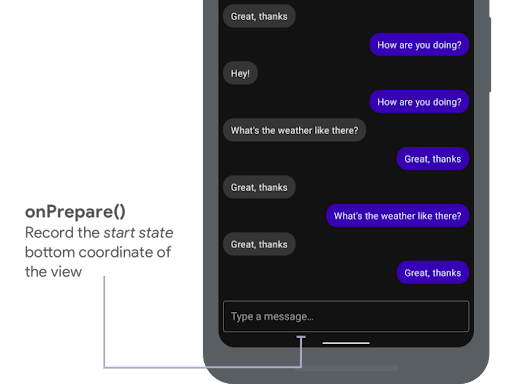
onPrepare() 记录开始状态。
以下代码段显示了对 onPrepare 的调用示例:
Kotlin
var startBottom = 0f

override fun onPrepare(
  animation: WindowInsetsAnimationCompat
) {
  startBottom = view.bottom.toFloat()
}
Java
float startBottom;

@Override
public void onPrepare(
    @NonNull WindowInsetsAnimationCompat animation
) {
  startBottom = view.getBottom();
}
当插边动画开始播放时,系统会调用 onStart。您可以使用它将所有视图属性设置为布局更改的最终状态。如果您已为任何视图设置 OnApplyWindowInsetsListener 回调,则系统会在此时调用该回调。此时是保存视图属性最终状态的好时机。
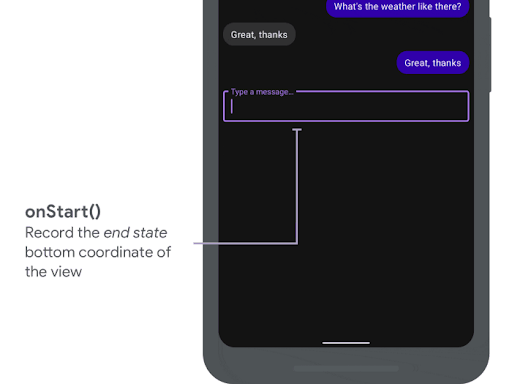
onStart() 记录结束状态。
以下代码段显示了对 onStart 的调用示例:
Kotlin
var endBottom = 0f

override fun onStart(
  animation: WindowInsetsAnimationCompat,
  bounds: WindowInsetsAnimationCompat.BoundsCompat
): WindowInsetsAnimationCompat.BoundsCompat {
  // Record the position of the view after the IME transition.
  endBottom = view.bottom.toFloat()

  return bounds
}
Java
float endBottom;

@NonNull
@Override
public WindowInsetsAnimationCompat.BoundsCompat onStart(
    @NonNull WindowInsetsAnimationCompat animation,
    @NonNull WindowInsetsAnimationCompat.BoundsCompat bounds
) {
  endBottom = view.getBottom();
  return bounds;
}
当插边在运行动画时发生变化时,系统会调用 onProgress,因此您可以替换它,并在键盘动画期间的每一帧收到通知。更新视图属性,使视图与键盘同步动画显示。
此时,所有布局更改均已完成。例如,如果您使用 View.translationY 来平移视图,则每次调用此方法时,该值都会逐渐减小,最终达到 0,即原始布局位置。
onProgress() 同步动画。
以下代码段显示了对 onProgress 的调用示例:
Kotlin
override fun onProgress(
  insets: WindowInsetsCompat,
  runningAnimations: MutableList<WindowInsetsAnimationCompat>
): WindowInsetsCompat {
  // Find an IME animation.
  val imeAnimation = runningAnimations.find {
    it.typeMask and WindowInsetsCompat.Type.ime() != 0
  } ?: return insets

  // Offset the view based on the interpolated fraction of the IME animation.
  view.translationY =
    (startBottom - endBottom) * (1 - imeAnimation.interpolatedFraction)

  return insets
}
Java
@NonNull
@Override
public WindowInsetsCompat onProgress(
    @NonNull WindowInsetsCompat insets,
    @NonNull List<WindowInsetsAnimationCompat> runningAnimations
) {
  // Find an IME animation.
  WindowInsetsAnimationCompat imeAnimation = null;
  for (WindowInsetsAnimationCompat animation : runningAnimations) {
    if ((animation.getTypeMask() & WindowInsetsCompat.Type.ime()) != 0) {
      imeAnimation = animation;
      break;
    }
  }
  if (imeAnimation != null) {
    // Offset the view based on the interpolated fraction of the IME animation.
    view.setTranslationY((startBottom - endBottom)

        *   (1 - imeAnimation.getInterpolatedFraction()));
  }
  return insets;
}
您可以选择替换 onEnd。此方法在动画结束时调用。现在是清理所有临时更改的好时机。
其他资源
- GitHub 上的 WindowInsetsAnimation。