
SplitRadioButton
Functions summary
Unit |
@ComposableThe Wear Material |
Functions
SplitRadioButton
@Composable
fun SplitRadioButton(
    selected: Boolean,
    onSelectionClick: () -> Unit,
    selectionContentDescription: String?,
    onContainerClick: () -> Unit,
    modifier: Modifier = Modifier,
    enabled: Boolean = true,
    shape: Shape = RadioButtonDefaults.splitRadioButtonShape,
    colors: SplitRadioButtonColors = RadioButtonDefaults.splitRadioButtonColors(),
    selectionInteractionSource: MutableInteractionSource? = null,
    containerInteractionSource: MutableInteractionSource? = null,
    transformation: SurfaceTransformation? = null,
    containerClickLabel: String? = null,
    contentPadding: PaddingValues = RadioButtonDefaults.ContentPadding,
    secondaryLabel: (@Composable RowScope.() -> Unit)? = null,
    label: @Composable RowScope.() -> Unit
): Unit
The Wear Material SplitRadioButton offers two slots and a specific layout for a label and secondaryLabel. The secondaryLabel is optional. The items are laid out with a column containing the two label slots and radio button control at the end.
The SplitRadioButton is Stadium shaped. The label should take no more than 3 lines of text. The secondary label should take no more than 2 lines of text. With localisation and/or large font sizes, the SplitRadioButton height adjusts to accommodate the contents. The label and secondary label are start aligned by default.
A SplitRadioButton has two tappable areas, one tap area for the labels and another for the selection control. The onContainerClick listener will be associated with the main body of the split radio button with the onSelectionClick listener associated with the selection control area only.
Samples: Example of a SplitRadioButton:
import androidx.compose.foundation.layout.Column
import androidx.compose.foundation.layout.Spacer
import androidx.compose.foundation.layout.fillMaxWidth
import androidx.compose.foundation.layout.height
import androidx.compose.foundation.layout.padding
import androidx.compose.foundation.selection.selectableGroup
import androidx.compose.runtime.mutableStateOf
import androidx.compose.runtime.remember
import androidx.compose.ui.Modifier
import androidx.compose.ui.text.style.TextOverflow
import androidx.compose.ui.unit.dp
import androidx.wear.compose.material3.RadioButton
import androidx.wear.compose.material3.SplitRadioButton
import androidx.wear.compose.material3.Text

Column(modifier = Modifier.selectableGroup().padding(horizontal = 10.dp)) {
    var selectedButton by remember { mutableStateOf(0) }
    // SplitRadioButton uses the Radio selection control by default.
    SplitRadioButton(
        label = { Text("First Button", maxLines = 3, overflow = TextOverflow.Ellipsis) },
        selected = selectedButton == 0,
        onSelectionClick = { selectedButton = 0 },
        selectionContentDescription = "First",
        onContainerClick = {
            /* Do something */
        },
        containerClickLabel = "click",
        modifier = Modifier.fillMaxWidth(),
        enabled = true,
    )
    Spacer(modifier = Modifier.height(4.dp))
    SplitRadioButton(
        label = { Text("Second Button", maxLines = 3, overflow = TextOverflow.Ellipsis) },
        selected = selectedButton == 1,
        onSelectionClick = { selectedButton = 1 },
        selectionContentDescription = "Second",
        onContainerClick = {
            /* Do something */
        },
        containerClickLabel = "click",
        modifier = Modifier.fillMaxWidth(),
        enabled = true,
    )
}
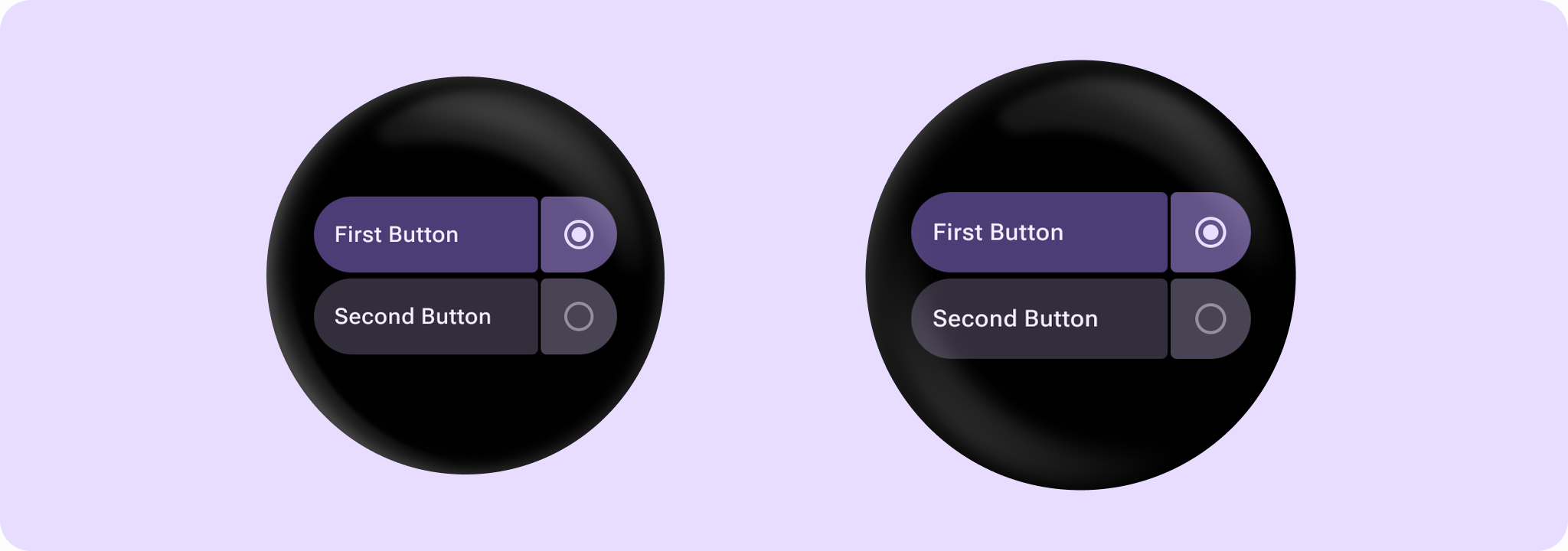
For a SplitRadioButton the background of the tappable background area behind the selection control will have a visual effect applied to provide a "divider" between the two tappable areas.
The recommended set of colors can be obtained from RadioButtonDefaults, e.g. RadioButtonDefaults.splitRadioButtonColors.
SplitRadioButton can be enabled or disabled. A disabled button will not respond to click events.
| Parameters | |
|---|---|
selected: Boolean |
Boolean flag indicating whether this button is currently selected. |
onSelectionClick: () -> Unit |
Callback to be invoked when this button has been selected. |
selectionContentDescription: String? |
The content description for the selection control part of the component |
onContainerClick: () -> Unit |
Click listener called when the user clicks the main body of the button, the area containing the labels. |
modifier: Modifier = Modifier |
Modifier to be applied to the button. |
enabled: Boolean = true |
Controls the enabled state of the button. When |
shape: Shape = RadioButtonDefaults.splitRadioButtonShape |
Defines the button's shape. It is strongly recommended to use the default as this shape is a key characteristic of the Wear Material Theme. |
colors: SplitRadioButtonColors = RadioButtonDefaults.splitRadioButtonColors() |
|
selectionInteractionSource: MutableInteractionSource? = null |
an optional hoisted |
containerInteractionSource: MutableInteractionSource? = null |
an optional hoisted |
transformation: SurfaceTransformation? = null |
Transformation to be used when button appears inside a container that needs to dynamically change its content separately from the background. |
containerClickLabel: String? = null |
Optional click label on the main body of the button for accessibility. |
contentPadding: PaddingValues = RadioButtonDefaults.ContentPadding |
The spacing values to apply internally between the container and the content. |
secondaryLabel: (@Composable RowScope.() -> Unit)? = null |
A slot for providing the button's secondary label. The contents are expected to be "start" aligned. |
label: @Composable RowScope.() -> Unit |
A slot for providing the button's main label. The contents are expected to be text which is "start" aligned. |